The workshop is split into 2 sessions:
June 28, 2016
1-Day GoldSim Workshop September 2016
Posted by Jason Lillywhite
GoldSim Technology Group is collaborating with the Arizona Hydrological Society this coming September to provide a 1-day software training workshop as part of their annual conference. The training workshop is only $75 per attendee and a great opportunity for networking and learning more about water resources issues in the Southwestern U.S. Net proceeds from the cost of the workshop will be donated to AHS to support scholarship and internship programs.
The workshop is split into 2 sessions:
June 13, 2016
Using Arrays in GoldSim
Posted by Ryan Roper
One of the most powerful features of GoldSim is its support for vector and matrix data types, or arrays. Whether you are modeling different age cohorts in a population dynamics model or you need to calculate monthly and/or yearly flow totals in a water resource model, the use of arrays can reduce complexity in your model and help you calculate useful results. If you are developing a contaminant transport model, using arrays is unavoidable since species properties are stored in vectors.
Proficiency with arrays in GoldSim is essential for many applications. Gaining a rudimentary understanding will require that you at least know how to create and use array label sets (named and indexed) and how to reference values in an array. I would definitely encourage you, though, to go beyond a basic proficiency and take advantage of the advanced capabilities that GoldSim provides. This blog post will point you to resources to help you get familiar with and start using arrays in GoldSim. I will highlight some example applications that range from very basic usage of arrays to sophisticated applications involving the use of array constructors.
![]() |
| Monthly cumulative flow results (see webinar 'Introduction to Arrays') |
Proficiency with arrays in GoldSim is essential for many applications. Gaining a rudimentary understanding will require that you at least know how to create and use array label sets (named and indexed) and how to reference values in an array. I would definitely encourage you, though, to go beyond a basic proficiency and take advantage of the advanced capabilities that GoldSim provides. This blog post will point you to resources to help you get familiar with and start using arrays in GoldSim. I will highlight some example applications that range from very basic usage of arrays to sophisticated applications involving the use of array constructors.
June 7, 2016
Annual Recurrence Interval of Reservoir Spills
Posted by Jason Lillywhite
Models are built to better inform decisions. Unfortunately, the numerous disparate outputs of statistical models are often difficult to make sense of for the decision makers and/or stakeholders. Compiling the risk of specific events potentially occurring in the future into a single variable can considerably assist the decision makers into comparing the various trade-offs between different scenarios.
One of our long-time GoldSim users, Simon Chambert of Macroscopia submitted a model to our Model Library that is helpful for those looking for the recurrence interval of an event like a pond overflowing. Both the recurrence interval and exceedence probability are computed and displayed for a given set of input parameters that describe the pond design and constraints. This example can be used for other models that need to compute an annual recurrence interval.
Models are built to better inform decisions. Unfortunately, the numerous disparate outputs of statistical models are often difficult to make sense of for the decision makers and/or stakeholders. Compiling the risk of specific events potentially occurring in the future into a single variable can considerably assist the decision makers into comparing the various trade-offs between different scenarios.
One of our long-time GoldSim users, Simon Chambert of Macroscopia submitted a model to our Model Library that is helpful for those looking for the recurrence interval of an event like a pond overflowing. Both the recurrence interval and exceedence probability are computed and displayed for a given set of input parameters that describe the pond design and constraints. This example can be used for other models that need to compute an annual recurrence interval.
May 19, 2016
Application of the Markov Process Rainfall Model
Posted by Jason Lillywhite
If you have visited our Model Library lately, you might have noticed that we have a nice little example model that demonstrates the use of a Markov process to simulate daily rainfall. You need to specify some key statistical inputs that have some basis on historic data. How do you develop these inputs? How do you know if the Markov model is realistic? I thought it would be helpful to show how this simple example might be applied in a real-world project and try to answer those questions.
*Note that I made changes to the results on 5/20/2016 after I used GoldSim's optimization function to better calibrate the rate variability.
If you have visited our Model Library lately, you might have noticed that we have a nice little example model that demonstrates the use of a Markov process to simulate daily rainfall. You need to specify some key statistical inputs that have some basis on historic data. How do you develop these inputs? How do you know if the Markov model is realistic? I thought it would be helpful to show how this simple example might be applied in a real-world project and try to answer those questions.
*Note that I made changes to the results on 5/20/2016 after I used GoldSim's optimization function to better calibrate the rate variability.
Labels:
calibration,
climate,
fit,
hydrology,
markov,
model,
optimization,
precipitation,
rainfall,
water
May 5, 2016
Automatically Export GoldSim Plots as Image Files
Posted by Jason Lillywhite
Over the last few years, some users have asked us for a feature that automatically exports images of plots in a GoldSim model. This is useful if you want to quickly update many plots used for a report but it is currently not a feature supported by GoldSim. Luckily, there is a fairly straightforward workaround that involves the help of a macro enabled Excel spreadsheet. In this post, I will walk through the steps to build this functionality using a simple example model. Using the simple example that I've created, you just run the model and images of all the plots of exported results are saved immediately.
April 21, 2016
Using GoldSim to Estimate Forecasting Parameters from Data
Posted by Ryan Roper
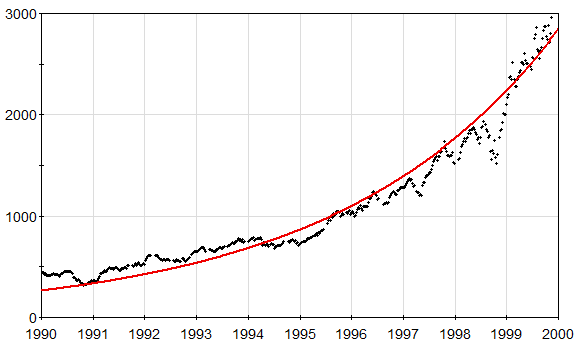
Recently, a customer contacted me to ask how to estimate parameters of a best-fit trend line for data stored in a Time Series element. The solution had to be sufficiently generic for multiple data sets and the fitting had to occur at the beginning of a simulation so that the parameters could be used for forecasting. The first solution I proposed used a SubModel with the optimization capability enabled. This worked well for a few data sets, but the solution needed to be scaled up to work efficiently for dozens of data sets on a single run. By the time I had implemented the approach for 10 data sets, I could see that the run time was going to be too long.
Since we had a known equation to fit to the data, I decided to implement a solution using the Gauss-Newton algorithm, an iterative nonlinear least-squares method for fitting trend lines to data (see Gauss-Newton Algorithm). This solution dramatically reduced the computation time and still gave great results. Since I think this solution could be of interest to many users in a variety of application areas, I put together a nice example model and posted it to our model library: Gauss-Newton Trend Line Fitting. In this blog post, I describe the implementation and show some results.
Recently, a customer contacted me to ask how to estimate parameters of a best-fit trend line for data stored in a Time Series element. The solution had to be sufficiently generic for multiple data sets and the fitting had to occur at the beginning of a simulation so that the parameters could be used for forecasting. The first solution I proposed used a SubModel with the optimization capability enabled. This worked well for a few data sets, but the solution needed to be scaled up to work efficiently for dozens of data sets on a single run. By the time I had implemented the approach for 10 data sets, I could see that the run time was going to be too long.Since we had a known equation to fit to the data, I decided to implement a solution using the Gauss-Newton algorithm, an iterative nonlinear least-squares method for fitting trend lines to data (see Gauss-Newton Algorithm). This solution dramatically reduced the computation time and still gave great results. Since I think this solution could be of interest to many users in a variety of application areas, I put together a nice example model and posted it to our model library: Gauss-Newton Trend Line Fitting. In this blog post, I describe the implementation and show some results.
March 30, 2016
Simulating Active Feedback Control in Engineered Systems
Posted by Rick Kossik
Most real-world models contain many interacting (positive and negative) feedback loops. Some feedback loops are “natural” and cannot be readily managed or controlled (e.g., water evaporating from a pond is an example of a process that forms a negative feedback loop). Others, however, are “intentional” negative feedback loops that are used for active feedback control of a system. That is, these are feedback loops that are part of the design of the system, and are used to make the system behave in a specified manner. A heating system controlled by a thermostat is the classic example of such feedback control. Pumping water to maintain a target water level is a simple water resource example. We discussed using GoldSim to represent such systems in our January webinar.
February 29, 2016
New GoldSim Help Desk
Posted by Ryan Roper
If you haven't noticed yet, we are now managing our support communications using a cloud-based customer service platform called Zendesk. You can visit the GoldSim Help Desk here: http://support.goldsim.com/.
After spending about a month evaluating Zendesk, we decided that this would be an excellent system for helping to track and document interactions that we have with you. It's also a great environment for maintaining a knowledge base of helpful support articles.
If you haven't noticed yet, we are now managing our support communications using a cloud-based customer service platform called Zendesk. You can visit the GoldSim Help Desk here: http://support.goldsim.com/.
After spending about a month evaluating Zendesk, we decided that this would be an excellent system for helping to track and document interactions that we have with you. It's also a great environment for maintaining a knowledge base of helpful support articles.
February 18, 2016
New GoldSim Licensing System Now Available
Posted by Rick Kossik
In a previous post, I noted that we will be rolling out a new licensing system. The system has now officially been implemented. Over the next several months, we will be rolling the system out to existing users. To continue to use GoldSim, you will need
to migrate your license over to the new licensing system. The
conversion process is straightforward, and should not take long (minutes in
most cases). You can read about the details of the new licensing system here.
Note that all licenses (even older licenses with expired maintenance) will need
to be converted (there is no cost involved).
The new system has a number of powerful advantages,
particularly for organizations with multiple licenses and/or floating
licenses. Hence, we will be contacting these organizations over the next
month to begin the conversion process. For everyone else, you do not need to
change over immediately. Instead,
whenever a license expires or needs to be renewed, we will convert it over to
the new system. Having said that, regardless of how straightforward the
conversion is, it always has the potential to disrupt some users, so executing
it on your schedule (rather than waiting for your license to expire) is
recommended. Hence, if you would like to convert over immediately (and not wait
until your license needs to be renewed), you can switch over to the new system
now by contacting us.
January 13, 2016
Central Arizona Project - Service Area Model
Posted by Jason LillywhiteGoldSim is being used by engineers and planners at Central Arizona Project to simulate water management in an area experiencing rapid growth coupled with uncertainties about future water supply, demand and reliability.
The Central Arizona Project Service Area Model (CAP:SAM) was developed by in-house staff using GoldSim software to simulate water demands for all major water using entities in the CAP three county Service Area, and the water supplies they use to meet their demands. The model can be used to simulate a wide range of future conditions including variable rates and patterns of growth, shortage impacts, effluent reuse, aquifer recharge and recovery, and complex supply portfolio management decisions on an annual time step.
Labels:
allocation,
applications,
arizona,
CAP,
demands,
supply,
water
December 23, 2015
Time Series: Modeling Changing Amounts Over Periods
Posted by Jason Lillywhite
A common modeling requirement in GoldSim is to represent movement of (or changes in) amounts of material over time intervals. Common examples we have seen from our users are flows through a pipe, site runoff, and rainfall amounts. Representing this type of data can be challenging if you are not used to GoldSim's way of explicitly defining data in the Time Series element. I think a reason for this is due to our familiarity with spreadsheets, which do not require explicitly defining how the data is represented.
December 4, 2015
Top Downloads from the GoldSim Model Library
Posted by Jason Lillywhite
We are continually updating and maintaining models in our Model Library in order to help our customers answer complex questions. You may not be aware but we now have 170 models in our library which are all available for all GoldSim users. These models are either built for a specific application or just to demonstrate a generic functionality of the software. It turns out that our most widely used model examples are application specific.
We track how often each of our models are downloaded and so I thought it might be helpful for you to see which ones are the most popular. Below is a summary of our most popular model library downloads since the inception of our library in early 2013. The models listed below are shown in order of popularity, with our most popular model shown first.
We are continually updating and maintaining models in our Model Library in order to help our customers answer complex questions. You may not be aware but we now have 170 models in our library which are all available for all GoldSim users. These models are either built for a specific application or just to demonstrate a generic functionality of the software. It turns out that our most widely used model examples are application specific.We track how often each of our models are downloaded and so I thought it might be helpful for you to see which ones are the most popular. Below is a summary of our most popular model library downloads since the inception of our library in early 2013. The models listed below are shown in order of popularity, with our most popular model shown first.
November 24, 2015
New Licensing Tools Coming to GoldSim in Early 2016
Posted by Rick Kossik
Software licensing tools are usually intended to be something that neither the user (you) nor the software vendor (us) want to have to think about often. In a perfect world, you activate or register your software, and then don't want to have to think about it again for a long time (e.g., perhaps until you upgrade the license or extend the maintenance subscription one year later). Although this is the case for many people, we have found that a growing number of our users want more flexibility and capabilities with how they manage their licenses. To address this, we've spent the last year implementing a powerful new licensing system that among other things, will make it easier for users to track and share licenses within an organization. In this blog, I provide a quick overview of the new licensing features.
November 11, 2015
Dynamic Coupling of GoldSim and MODFLOW / MT3D
Posted by Jason Lillywhite
From time to time, we hear from GoldSim users asking about the possibility of linking MODFLOW with GoldSim dynamically. This is important because the combined model is useful for integrating accurate groundwater flow and transport models with decision support, hydrologic, and probabilistic models built in GoldSim. Folks at Barr Engineering were able to pull this off using a realistic hypothetical application and presented their application at the poster session of our 2015 User Conference.
Labels:
coupled,
dll,
dynamic,
groundwater,
link,
mine water,
modflow
October 27, 2015
GoldSim Training Course in Tucson in December
Posted by Rick Kossik
I'll be teaming with Dave Hoekstra of SRK Consulting to teach a 3-day course entitled "Developing Mine Water Balances in GoldSim" December 3-5 in Tucson. This course is being held in conjunction with the Society for Mining, Metallurgy, & Exploration (SME) Arizona Conference. I'll be leading the first two days, which are targeted at people new to GoldSim and will cover basic use of GoldSim. Dave will spend the third day focusing on water balance modeling. If you are already familiar with GoldSim, you can attend just the third day. You can read more about the course and register here.
October 20, 2015
Powerful Decision Making for a Phosphate Mine
Posted by Jason Lillywhite
One of the winners of the 2015 User Conference poster session presented on a GoldSim application for a phosphate mine in central Florida. After reading more about this application, I began to better appreciate the great work that Cardno has been involved in. The phosphate mining industry faces very strict effluent limitations while having to manage several hundred gallons of water around the site every day. The model must account for a continuously changing landscape of flow paths and operating schemes under varying hydrologic conditions. Read about how GoldSim is being used to help the mining company make better decisions as they comply with these changing regulations.October 14, 2015
Photos from the User Conference
Posted by Jason Lillywhite
The 2015 GoldSim User Conference was held September 24th and 25th in Seattle and was a big success. Here are some photos showing the highlights of the conference, including the social events and poster presentations.
September 29, 2015
GoldSim Model Beauty Contest Winner: Moneyball!
Posted by Rick Kossik
A tradition at our User Conference is to hold a "Model Beauty Contest". The Beauty Contest is held at the end of the Conference, and is intended to allow our users to focus on the fun side of modeling and simulation. Beauty Contest entries typically describe a modeling application that is light-hearted (such as a game), amusing (e.g., probabilistically simulating the length of the restroom lines at a football stadium), or simply entertaining. This year's winner (as determined by a vote of attendees) was Joe Donnelly's "Moneyball" model.
September 28, 2015
GoldSim User Conference Poster Session
Posted by Rick Kossik
We just wrapped up our User Conference in downtown Seattle, and it was lots of fun. The conference was attended by nearly 60 people from six countries. In addition to invited papers, a panel discussion, and a day of advanced training, one of the highlights of the conference was the poster session, where attendees presented a wide variety of interesting GoldSim applications. This post provides a list of poster abstracts and presents the winners (as selected by attendees) of the best poster presentation.
September 22, 2015
Pre-Conference Training has Started!
Posted by Ryan Roper
Advanced training on the first day of the conference will be a mix of training classes and informal discussions in which attendee participation is encouraged. The day will end with a fun social event on a privately chartered boat ride in the Puget Sound. On the last day of the conference, presentations of invited papers, poster presentations and a panel discussion will provide opportunities for attendees to network, share experiences and participate in interesting discussions.We expect to have a really great time this week!
Subscribe to:
Posts (Atom)